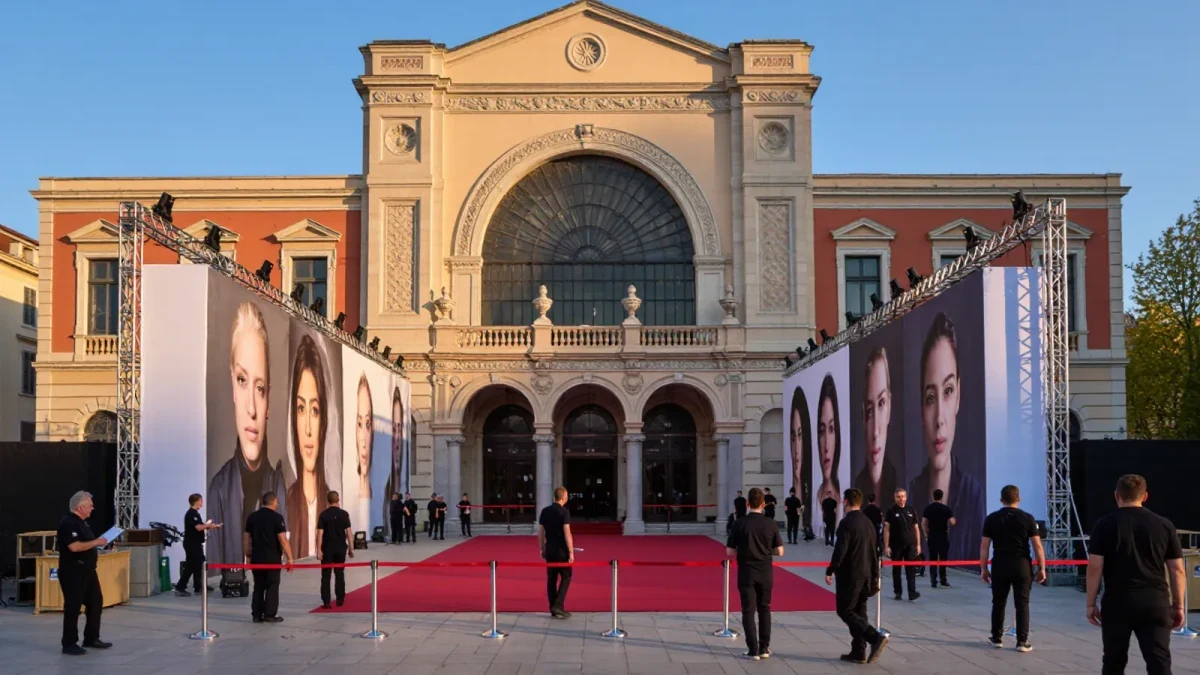
A major studio premiere typically runs between $100,000 and $1 million before after-party costs, according to event producers and publicists who work awards-adjacent releases. That figure covers the venue, the carpet build, lighting, security, press risers and the staff to manage it all. The number moves with the film's box office ambitions: a platform release for an auteur title and a four-quadrant tentpole premiere are, financially, different products.
What drives the largest share of a premiere budget?
The venue and the carpet build usually consume the biggest single blocks. Renting a 1,000-plus-seat house in Los Angeles, New York or London for an evening can cost tens of thousands of dollars, and studio lots are cheaper but carry their own union staffing minimums. The carpet itself — framing, backdrop walls printed with artwork and partner logos, step-and-repeat, lighting trusses and climate control — is a temporary construction project billed like one.
How much does the red carpet build itself cost?
Producers describe carpet builds in the range of $50,000 to $250,000 for a top-tier premiere, depending on length and finish. Backdrop walls, barricades, press risers and photographer positions each add line items. If a street closure is required, city permits, police detail and traffic management push costs higher. A festival carpet, built and rebuilt nightly, is priced differently from a one-night studio build.
What does talent logistics add?
Flights, hotels, cars, glam teams and security for principal cast are frequently billed to the film's P&A budget rather than the event budget, which is one reason headline premiere costs are hard to pin down from outside. A single A-lister's arrival — armoured car service, personal security of two to four agents, a styling team paid day rates that trade press has reported in the five-figure range — can exceed the entire carpet build for a modest independent film.
Who pays for all of it?
The distributor pays. For a studio release, the premiere sits inside the prints-and-advertising budget, the same pool that funds television spots and outdoor advertising. For independent films, the premiere is often split between the distributor and a venue partner, and sometimes underwritten by a brand sponsor that buys naming position on the backdrop in exchange for a fee estimated by sponsorship brokers at $50,000 to $500,000 for top-tier carpet placement.
How do brand partnerships offset the bill?
Champagne houses, watch brands and fashion houses underwrite premieres in exchange for category exclusivity on the carpet and in the after-party. Sponsorship brokers describe deals in which a luxury partner covers gifting, bar service or the after-party entirely. The studio trades something it values less — signage, product placement at the party — for cash or in-kind services it would otherwise buy.
What does the guest list actually cost to manage?
Guest management is labor. A premiere with 800 to 1,500 guests requires a check-in operation, invitations, seat assignments, gift-bag assembly and wranglers for talent arrivals. Staffing agencies quote per-head figures for event staff, and publicists manage invites across cast, filmmakers, press, executives and contest winners. Over-inviting is deliberate: producers assume a 15 to 25 percent no-show rate and pad the list accordingly.
How much is the after-party?
After-parties can match or exceed the screening itself. Producers describe budgets from $100,000 for a hotel-based reception to well past $500,000 for a built-out takeover with custom decor, branded bars and a DJ or performance fee. Food, alcohol, florals, furniture rental and a second security footprint are each separate contracts. The party, not the screening, is where the sponsorship money concentrates.
Do independent films premiere for less?
They do, by an order of magnitude. An independent film premiering at a festival pays a submission fee, not a venue fee, and the festival absorbs the carpet, projection and staffing. A standalone indie premiere in Los Angeles or New York — a rented theater, a modest step-and-repeat, a dinner for forty — can be produced for $10,000 to $50,000, and publicists say many are done for less when venues donate space.
What is the return the studios are buying?
The premiere is a content factory. The carpet generates photography that feeds entertainment media for days, a trailer placement in news coverage that cannot be bought as advertising at equivalent rates, and social posts from attendees with follower counts in the tens of millions. Marketing executives treat the spend as earned-media arbitrage: a seven-figure premiere that produces thousands of publishable photographs and clips is measured against the cost of buying equivalent impressions.
Where does the money go, in rough shares?
- Venue and screening operations: 20-30 percent of a typical studio premiere budget, including projection, staffing and house costs.
- Carpet build and dressings: 20-35 percent, including backdrops, barricades, lighting and permits.
- After-party: 25-40 percent, often partially offset by sponsors.
- Security and logistics: 10-15 percent, scaling sharply with cast profile.
- Press operations and staffing: 5-10 percent, including risers, publicist teams and gift bags.
Why do the numbers stay fuzzy?
Because no two invoices look alike. Studio premiere costs sit inside P&A reporting that is not public, sponsors offset lines invisibly, and talent costs are booked elsewhere. The ranges that circulate among producers and publicists are consistent — six figures for a serious premiere, seven for a tentpole with a built party — but the industry has no standardized disclosure, so every figure is an estimate from practitioners rather than a filed number.
How do premieres differ between Los Angeles, London and festival cities?
Geography changes the invoice. Los Angeles premieres benefit from dense vendor ecosystems and studio-adjacent venues, which keeps logistics costs contained but raises demand premiums on peak weeks. London premieres — frequently staged in Leicester Square with street closures — carry municipal costs that require council coordination and added security. Festival-city premieres in Cannes or Venice fold into festival infrastructure, though hotel scarcity during those weeks makes talent accommodation the single most inflated line item on the budget.
How far in advance is a premiere planned?
Top-tier premieres lock venues and dates eight to twelve weeks out, with carpet fabricators and staging companies booked on studio call sheets well before invitations print. Publicists begin guest-list architecture at the same time, sequencing cast availability, director obligations and executive attendance. Last-minute shifts are expensive: rescheduling a built event within two weeks of the date can forfeit deposits across multiple vendor contracts, which is why premiere dates rarely move once announced.
For more context, read How 3D and Large-Format Premieres Are Technically Staged.
For more context, read independent film distribution.
For more context, read academy awards eligibility.